REGENXBIO REPORTS NEW POSITIVE INTERIM DATA FROM PHASE I/II AFFINITY DUCHENNE® TRIAL OF RGX-202
PR Newswire
ROCKVILLE, Md., March 11, 2026
- Investigational RGX-202 continues to demonstrate evidence of positively changing disease trajectory for Duchenne
- Pivotal dose participants exceeded external controls across functional measures at 1 year, including participants aged 8+
- Cardiac MRI data for pivotal dose patients demonstrated stability at 1 year
- Favorable safety profile continued with no serious adverse events or adverse events of special interest observed in Phase I/II study
- New data from multiple measures supported liver safety in pivotal patients
- Pivotal topline data expected Q2 2026
ROCKVILLE, Md., March 11, 2026 /PRNewswire/ -- REGENXBIO Inc. (Nasdaq: RGNX) today announced new positive interim data from the Phase I/II AFFINITY DUCHENNE trial of RGX-202, a potential best-in-class gene therapy for Duchenne muscular dystrophy. Trial investigator Carolina Tesi-Rocha, M.D., Clinical Professor, Neurology, Stanford School of Medicine, Stanford Children's Health, is presenting this data, including new functional, safety, biomarker, and cardiac MRI measures, at the Muscular Dystrophy Association (MDA) Clinical and Scientific Conference.
"Today's new Phase I/II interim data demonstrates continued positive impact on function, stable cardiac health, and a favorable safety profile, highlighting the potential of RGX-202 to be a differentiated gene therapy option for Duchenne," said Steve Pakola, M.D., Chief Medical Officer of REGENXBIO. "Our proactive, comprehensive approach to safety combined with our novel microdystrophin construct are supported by the sustained safety and durable functional outcomes through two years post-treatment. As we approach our topline pivotal data readout in early Q2, we are very encouraged by this thorough new dataset and the opportunity to advance RGX-202 as a potential meaningful treatment option for patients."
"Duchenne is a devastating, degenerative disease that robs children of muscle strength and independence over time, and I'm pleased to see the continued positive safety and encouraging efficacy profile of RGX-202," said Dr. Tesi-Rocha. "These positive Phase I/II data, including biomarker results, functional improvement, cardiac stability, and liver safety provide a clearer picture of RGX-202's potential impact across key measures of health in Duchenne."
AFFINITY DUCHENNE Phase I/II Interim Data Updates (data cut: January 5, 2026)
Functional Data
In the interim functional results from seven participants treated at the pivotal dose level (2x10¹⁴ GC/kg), aged approximately 6 to 12 years at dosing, RGX-202 continues to demonstrate evidence of positively impacting disease trajectory on North Star Ambulatory Assessment (NSAA) and all timed function tests (Time to Stand, 10 Meter Walk-run, Time to Climb) at one year.
Functional outcomes were analyzed using multiple validated methods to estimate expected disease progression without treatment, including the cTAP disease progression model and external control comparisons using coarsened exact matching and propensity score weighting. Propensity score weighting is the primary analysis method specified in the SAP for the pivotal trial.
The pivotal dose participants demonstrated improved performance across all timed function tests and NSAA when compared to external control using propensity score weighting. The 95% confidence interval demonstrates favorability to RGX-202. [Figure 1]

On NSAA, pivotal dose participants exceeded expected disease trajectory and external controls. Notably, five of the seven participants were aged 8+ at dosing, when functional decline is expected. At one year, participants (n=7) improved an average of +4.9 points compared to cTAP. The older participants (n=5) improved an average of +5.2 points compared to cTAP. [Figure 2]
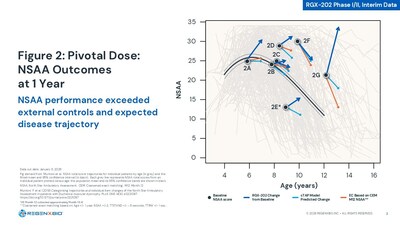
Additionally, dose level 1 (1x10¹⁴ GC/kg) participants (n=3) exceeded expected disease trajectory and improved an average of +5.6 points compared to cTAP at two years. [Figure 3]

Cardiac Function
Pivotal dose participants demonstrated cardiac stability at one year post-treatment as measured by MRI endpoints, including mean left ventricular ejection fraction, global circumferential strain, and fibrosis assessed by late gadolinium enhancement.
Baseline | 12 Months | |
Subjects (N) | 7 | 7 |
Age Mean (range) | 8.7* (5.8-12.1)** | 9.7 (6.8-13.1) |
Left Ventricular Ejection Fraction Mean (range) Median | 61.7% (54-72)** 60% | 61.6% (57-74) 60% |
Global Circumferential Strain Mean (range) Median | -20.4% (-22% to -19%) -20.4% | -20.9% (-23% to -17%) -21.5% |
Late Gadolinium Enhancement (LGE) | 1 participant with | No change from baseline |
Biomarker Data
Biomarker data from the Phase I/II study continues to support consistent, high expression and transduction of RGX-202 microdystrophin (n=13). New data from an additional patient, aged 3.6 at dosing, had a microdystrophin expression level of 51.2% at Week 12. The primary endpoint in the pivotal phase of AFFINITY DUCHENNE is the proportion of participants whose RGX-202 microdystrophin expression is >10% at Week 12.
RGX-202 was appropriately localized to the sarcolemma, demonstrating that the differentiated construct with the inclusion of the C-Terminal (CT) domain is appropriately targeting the muscle.
Safety and Tolerability Data
New interim safety data from all Phase I/II pivotal dose participants aged 1 to <12 years at dosing show no evidence of liver injury across multiple measures. Mean gamma-glutamyl transferase (GGT) and total bilirubin, recognized markers of liver inflammation in Duchenne, did not exceed the upper limit of normal up to two years post-treatment. A mean reduction in creatine kinase was observed at one year post-treatment (n=8) and supported by mean reductions in ALT (n=7), AST (n=7) and LDH (n=8).
RGX-202 was well tolerated with no serious adverse events (SAEs) and no AEs of special interest (AESIs) in the Phase I/II study as of the data cut date (n=13). Common drug-related AEs included vomiting, fatigue, and nausea. All are typically anticipated with gene therapy administration. A proactive, short-course immune modulation regimen in combination with a differentiated construct and industry-leading product purity levels of more than 80% full capsids may contribute to a favorable safety profile for RGX-202.
AFFINITY DUCHENNE Trial
REGENXBIO expects to share topline pivotal data in early Q2 2026 and request a pre-BLA meeting with the FDA in mid-2026. The Company continues to enroll ~30 participants aged 1+ in the confirmatory trial of RGX-202 and expects to have the majority of this trial enrolled at the time of BLA submission.
About RGX-202
RGX-202 is a potential best-in-class investigational gene therapy designed for improved function and outcomes in Duchenne. RGX-202 is the only gene therapy approved or in late-stage development for Duchenne with a differentiated microdystrophin construct that encodes key regions of naturally occurring dystrophin, including the C-Terminal (CT) domain.
Additional design features such as codon optimization may potentially improve gene expression, increase protein translation efficiency and reduce immunogenicity. RGX-202 is designed to support the delivery and targeted expression of microdystrophin throughout skeletal and heart muscle using the NAV® AAV8 vector and a well-characterized muscle-specific promoter (Spc5-12). RGX-202 is manufactured by REGENXBIO using its proprietary, high-yielding NAVXpress® suspension-based platform process.
About Duchenne Muscular Dystrophy
Duchenne is a severe, progressive, degenerative muscle disease, affecting 1 in 3,500 to 5,000 boys born each year worldwide. Duchenne is caused by mutations in the Duchenne gene which encodes for dystrophin, a protein involved in muscle cell structure and signaling pathways. Without dystrophin, muscles throughout the body degenerate and become weak, eventually leading to loss of movement and independence, required support for breathing, cardiomyopathy and premature death.
ABOUT REGENXBIO Inc.
REGENXBIO is a biotechnology company on a mission to improve lives through the curative potential of gene therapy. Since its founding in 2009, REGENXBIO has pioneered the field of AAV gene therapy. REGENXBIO is advancing a late-stage pipeline of one-time treatments for rare and retinal diseases, including RGX-202 for the treatment of Duchenne; clemidsogene lanparvovec (RGX-121) for the treatment of MPS II and RGX-111 for the treatment of MPS I, both in partnership with Nippon Shinyaku; and surabgene lomparvovec (ABBV-RGX-314) for the treatment of wet AMD and diabetic retinopathy, in collaboration with AbbVie. Thousands of patients have been treated with REGENXBIO's AAV platform, including those receiving Novartis' ZOLGENSMA®. REGENXBIO's investigational gene therapies have the potential to change the way healthcare is delivered for millions of people. For more information, please visit www.regenxbio.com.
FORWARD-LOOKING STATEMENTS
This press release includes "forward-looking statements," within the meaning of Section 27A of the Securities Act of 1933, as amended, and Section 21E of the Securities Exchange Act of 1934, as amended. These statements express a belief, expectation or intention and are generally accompanied by words that convey projected future events or outcomes such as "believe," "may," "will," "estimate," "continue," "anticipate," "assume," "design," "intend," "expect," "could," "plan," "potential," "predict," "seek," "should," "would" or by variations of such words or by similar expressions. The forward-looking statements include statements relating to, among other things, REGENXBIO's future operations and clinical trials. REGENXBIO has based these forward-looking statements on its current expectations and assumptions and analyses made by REGENXBIO in light of its experience and its perception of historical trends, current conditions and expected future developments, as well as other factors REGENXBIO believes are appropriate under the circumstances. However, whether actual results and developments will conform with REGENXBIO's expectations and predictions is subject to a number of risks and uncertainties, including the timing of enrollment, commencement and completion and the success of clinical trials conducted by REGENXBIO, its licensees and its partners, the timely development and launch of new products, the ability to obtain and maintain regulatory approval of product candidates, the ability to obtain and maintain intellectual property protection for product candidates and technology, trends and challenges in the business and markets in which REGENXBIO operates, the size and growth of potential markets for product candidates and the ability to serve those markets, the rate and degree of acceptance of product candidates, and other factors, many of which are beyond the control of REGENXBIO. Refer to the "Risk Factors" and "Management's Discussion and Analysis of Financial Condition and Results of Operations" sections of REGENXBIO's Annual Report on Form 10-K for the year ended December 31, 2025, and comparable "risk factors" sections of REGENXBIO's Quarterly Reports on Form 10-Q and other filings, which have been filed with the SEC and are available on the SEC's website at WWW.SEC.GOV. All of the forward-looking statements made in this press release are expressly qualified by the cautionary statements contained or referred to herein. The actual results or developments anticipated may not be realized or, even if substantially realized, they may not have the expected consequences to or effects on REGENXBIO or its businesses or operations. Such statements are not guarantees of future performance and actual results or developments may differ materially from those projected in the forward-looking statements. Readers are cautioned not to rely too heavily on the forward-looking statements contained in this press release. These forward-looking statements speak only as of the date of this press release. Except as required by law, REGENXBIO does not undertake any obligation, and specifically declines any obligation, to update or revise any forward-looking statements, whether as a result of new information, future events or otherwise.
Zolgensma® is a registered trademark of Novartis AG. All other trademarks referenced herein are registered trademarks of REGENXBIO.
**One participant met LVEF criteria at baseline by ECHO of >55%; later cMRI had measure of 54
*** More negative strain values are better
Contacts:
Dana Cormack
Corporate Communications
dcormack@regenxbio.com
Investors:
George E. MacDougall
Investor Relations
IR@regenxbio.com

 View original content to download multimedia:https://www.prnewswire.com/news-releases/regenxbio-reports-new-positive-interim-data-from-phase-iii-affinity-duchenne-trial-of-rgx-202-302711193.html
SOURCE REGENXBIO Inc.