New York, USA, Feb. 02, 2026 (GLOBE NEWSWIRE) -- Limbal Stem Cell Deficiency Market Set to Transform During the Forecast Period (2025–2034) With Innovative Treatment Advances | DelveInsight
The dynamics of the limbal stem cell deficiency drugs market are anticipated to change owing to improvements in research and development, rising prevalence, and an aging population. Additionally, the expected launch of emerging therapies, such as Claris Biotherapeutics’ CSB-001, will further propel market growth.
DelveInsight’s Limbal Stem Cell Deficiency Market Insights report includes a comprehensive understanding of current treatment practices, emerging limbal stem cell deficiency drugs, market share of individual therapies, and current and forecasted limbal stem cell deficiency market size from 2020 to 2034, segmented into leading markets (the US, EU4, UK, and Japan).
Limbal Stem Cell Deficiency Market Summary
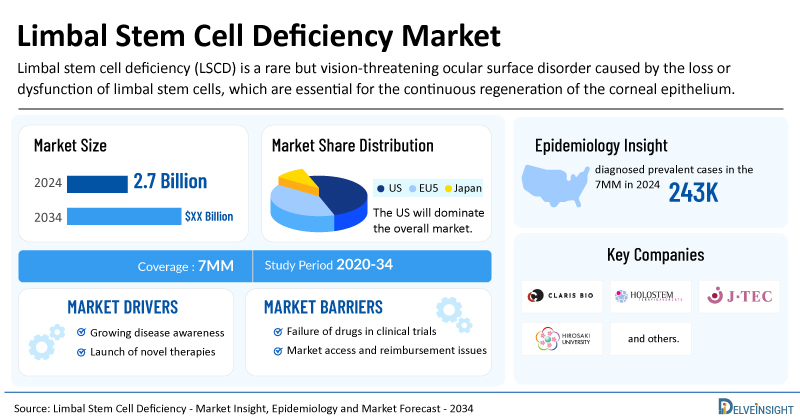
- 2024 US Limbal Stem Cell Deficiency Market Size: USD 2.7 Billion
- Largest Limbal Stem Cell Deficiency Market: United States (55%)
- 2024 Diagnosed Limbal Stem Cell Deficiency Prevalent Cases: 243K
- FDA-Approved Limbal Stem Cell Deficiency Drugs: HOLOCLAR (Holostem Terapie Avanzate), OCURAL (Japan Tissue Engineering Co., Ltd), and SAKRACY (Hirosaki Life Science Innovation)
- Key Limbal Stem Cell Deficiency Companies Developing Drugs: Claris Biotherapeutics and others.
- Key Limbal Stem Cell Deficiency Therapies in Clinical Trials: CSB-001, and others.
Discover which limbal stem cell deficiency medications are expected to grab the market share @ https://www.delveinsight.com/sample-request/limbal-stem-cells-deficiency-lsd-market?utm_source=globenewswire&utm_medium=pressrelease&utm_campaign=spr
Sadaf Javed, Manager of Forecasting and Analytics at DelveInsight, commented: “The increasing prevalence of limbal stem cell deficiency, coupled with improving disease awareness, is driving greater demand for timely diagnosis and therapeutic intervention. This trend is expected to expand the addressable patient population and unlock incremental market opportunities. In parallel, ongoing research into topical therapeutic approaches for LSCD represents a significant advancement, with the potential to offer less invasive alternatives to surgical interventions such as limbal stem cell transplantation, thereby reshaping the treatment landscape.”
Key Factors Driving the Growth of the Limbal Stem Cell Deficiency Market
- Rising LSCD Prevalence: Among the 7MM, the United States had the highest number of diagnosed prevalent LSCD cases in 2024, with approximately 100,000 cases, which are expected to increase during the forecast period (2025-2034).
- HOLOCLAR—A Promising Candidate for LSCD: Currently, there are no FDA-approved drugs for LSCD in the United States. However, in 2018, HOLOCLAR, a treatment involving autologous human corneal epithelial cells containing stem cells, received Orphan Drug Designation (ODD) from the US FDA. This recognition underscores the potential of HOLOCLAR to address this rare condition, paving the way for future treatment options.
- Claris Biotherapeutics Leads Innovation in LSCD Treatment: Claris Biotherapeutics is pioneering CSB-001, an innovative therapy with the potential to reshape the treatment landscape for LSCD. With limited competition in the pipeline, CSB-001 offers significant opportunities for market stakeholders, promising to bring new hope to patients and revolutionize the future of LSCD treatment.
Limbal Stem Cell Deficiency Market Analysis
- LSCD treatment combines surgical and medical approaches. Surgical options include stem cell transplants (autologous and allogeneic), CLET, SLET, and keratoprosthesis (KPro) or PKP for severe cases.
- Medical treatments include artificial tears, corticosteroids, amniotic membrane grafting, scleral lenses, and serum tears to support healing and manage symptoms.
- Currently, there are no FDA-approved drugs for LSCD in the United States. In 2018, HOLOCLAR, a treatment involving autologous human corneal epithelial cells containing stem cells, received Orphan Drug Designation (ODD) from the US FDA.
- This recognition underscores the potential of HOLOCLAR to address this rare condition, paving the way for future treatment options.
- The LSCD pipeline is limited, with CSB-001 (Claris Biotherapeutics) as the only emerging drug. The lack of understanding of LSCD etiology, along with complex diagnosis and treatment, creates significant unmet needs and healthcare burdens, especially in managing corneal blindness through stem cell-based therapies.
Learn more about the approved therapies for LSCD @ Limbal Stem Cell Deficiency Treatment Market
Limbal Stem Cell Deficiency Competitive Landscape
Claris Biotherapeutics is at the forefront of advancing CSB-001, a novel therapeutic candidate poised to transform the treatment paradigm for LSCD. With few competing assets in development, CSB-001 represents a compelling opportunity for industry stakeholders, offering renewed optimism for patients and the potential to redefine future LSCD management.
CSB-001 is a recombinant human dHGF-based ophthalmic formulation being developed by Claris Biotherapeutics for LSCD. Designed as a topical therapy, it is administered using a sterile droptainer, with a recommended dosing schedule of one drop four times daily. The product is stable at room temperature, supporting a patient-friendly and practical treatment approach.
Mechanistically, CSB-001 compensates for deficient hepatocyte growth factor (HGF) by engaging the c-MET receptor, a key mediator of corneal repair and regeneration. This differentiated mode of action has shown superior effectiveness in enhancing epithelial healing across corneal disorders. With its innovative biology and convenient delivery, CSB-001 holds strong potential to reshape LSCD treatment while creating meaningful value for both patients and market participants.
Aparna Thakur, Assistant Project Manager, Forecasting and Analytics at DelveInsight, commented: “The anticipated approval of novel therapies is expected to expand the treatment landscape and improve clinical outcomes. In particular, mesenchymal stromal stem cells (MSCs) and stem cells derived from allogeneic or autologous non-limbal sources have demonstrated encouraging potential and continue to represent key areas of focus within ongoing clinical research.”
To know more about pipeline therapies for LSCD, visit @ Limbal Stem Cell Deficiency Medication
What is Limbal Stem Cell Deficiency?
Limbal stem cell deficiency (LSCD) is a rare but vision-threatening ocular surface disorder caused by the loss or dysfunction of limbal stem cells, which are essential for the continuous regeneration of the corneal epithelium. When these cells are depleted, due to chemical or thermal burns, autoimmune diseases, long-term contact lens use, infections, or genetic conditions, the cornea loses its ability to maintain a clear, stable surface. This results in conjunctival overgrowth onto the cornea, chronic inflammation, recurrent epithelial defects, pain, photophobia, and progressive visual impairment. Early diagnosis is critical, as untreated LSCD can lead to irreversible corneal scarring and blindness, while advances in regenerative therapies and limbal stem cell transplantation are transforming long-term outcomes for affected patients.
Limbal Stem Cell Deficiency Epidemiology Segmentation
The limbal stem cell deficiency epidemiology section provides insights into the historical and current limbal stem cell deficiency patient pool and forecasted trends for the leading markets. Among the 7MM, the majority of LSCD cases diagnosed in 2024 were mild, followed by moderate and severe cases, with this trend anticipated to continue during the forecast period (2025-2034).
The limbal stem cell deficiency market report proffers epidemiological analysis for the study period 2020–2034 in the leading markets, segmented into:
- Total Diagnosed Prevalent Cases of LSCD
- Severity-specific Diagnosed Cases of LSCD
- Gender-specific Diagnosed Cases of LSCD
- Type-specific Diagnosed Cases of LSCD
- Cause-specific Diagnosed Cases of LSCD
Download the report to understand LSCD patient prevalence data by region with forecast @ LSCD Prevalence and Epidemiology Forecast
| Limbal Stem Cell Deficiency Market Report Metrics | Details |
| Study Period | 2020–2034 |
| Limbal Stem Cell Deficiency Market Report Coverage | 7MM [The United States, the EU-4 (Germany, France, Italy, and Spain), the United Kingdom, and Japan] |
| Limbal Stem Cell Deficiency Epidemiology Segmentation | Total Diagnosed Prevalent Cases of LSCD, Severity-specific Diagnosed Cases of LSCD, Gender-specific Diagnosed Cases of LSCD, Type-specific Diagnosed Cases of LSCD, and Cause-specific Diagnosed Cases of LSCD |
| Limbal Stem Cell Deficiency Market Size in 2024 | USD 2.7 Billion |
| Key Limbal Stem Cell Deficiency Companies | Claris Biotherapeutics, Holostem Terapie Avanzate, Japan Tissue Engineering Co., Ltd, Hirosaki Life Science Innovation, and others |
| Key Limbal Stem Cell Deficiency Therapies | CSB-001, HOLOCLAR, OCURAL, SAKRACY, and others |
Scope of the Limbal Stem Cell Deficiency Market Report
- Limbal Stem Cell Deficiency Therapeutic Assessment: Limbal Stem Cell Deficiency current marketed and emerging therapies
- Limbal Stem Cell Deficiency Market Dynamics: Conjoint Analysis of Emerging Limbal Stem Cell Deficiency Drugs
- Competitive Intelligence Analysis: SWOT analysis and Market entry strategies
- Limbal Stem Cell Deficiency Market Unmet Needs, KOL’s views, Analyst’s views, Limbal Stem Cell Deficiency Market Access and Reimbursement
Discover more about limbal stem cell deficiency drugs in development @ Limbal Stem Cell Deficiency Clinical Trials
Table of Contents
| 1 | Limbal Stem Cell Deficiency Market Key Insights |
| 2 | Limbal Stem Cell Deficiency Market Report Introduction |
| 3 | LSCD Market Overview at a Glance |
| 3.1 | Market Share (%) Distribution of LSCD in 2024 in the 7MM |
| 3.2 | Market Share (%) Distribution of LSCD in 2034 in the 7MM |
| 4 | Methodology |
| 5 | Executive Summary |
| 6 | Key Events |
| 7 | Disease Background and Overview |
| 7.1 | Introduction |
| 7.2 | Classification of LSCD |
| 7.3 | Clinical Manifestations |
| 7.4 | Etiology and Risk Factors |
| 7.5 | Pathophysiology |
| 7.6 | Diagnosis of LSCD |
| 8 | Treatment and Management of SUD |
| 8.1 | Management of LSCD |
| 8.2 | Treatment Guidelines |
| 9 | Epidemiology and Patient Population |
| 9.1 | Key Findings |
| 9.2 | Assumptions and Rationale |
| 9.3 | Total Diagnosed Prevalent Population of LSCD in the 7MM |
| 9.4 | The United States |
| 9.4.1 | Total Diagnosed Prevalent Cases of LSCD in the US |
| 9.4.2 | Severity-specific Diagnosed Cases of LSCD in the US |
| 9.4.3 | Gender-specific Diagnosed Cases of LSCD in the US |
| 9.4.4 | Type-specific Diagnosed Cases of LSCD in the US |
| 9.4.5 | Cause-specific Diagnosed Cases of LSCD in the US |
| 9.5 | The EU4 and the UK |
| 9.6 | Japan |
| 10 | Limbal Stem Cell Deficiency Patient Journey |
| 11 | Marketed Limbal Stem Cell Deficiency Therapies |
| 11.1 | Key Cross |
| 11.2 | HOLOCLAR (Autologous Human Corneal Epithelial Cells Containing Stem Cells): Holostem Terapie Avanzate |
| 11.2.1 | Product Description |
| 11.2.2 | Regulatory Milestones |
| 11.2.3 | Other Developmental Activities |
| 11.2.4 | Safety and Efficacy |
| 11.3 | OCURAL (Human [Autologous] Oral Mucosa-derived Epithelial Cell Sheet): Japan Tissue Engineering Co., Ltd (J-TEC) |
| 11.4 | SAKRACY (Human [autologous] oral mucosa-derived epithelial cell sheet using human amniotic membrane substrate): Hirosaki Life Science Innovation |
| 12 | Emerging Limbal Stem Cell Deficiency Therapies |
| 12.1 | CSB-001: Claris Biotherapeutics |
| 12.1.1 | Product Description |
| 12.1.2 | Clinical Developmental Activities |
| 12.1.3 | Analyst View |
| 13 | LSCD Market: The 7MM Analysis |
| 13.1 | Key Findings |
| 13.2 | Limbal Stem Cell Deficiency Market Outlook |
| 13.3 | Total Market Size of LSCD in the 7MM |
| 13.4 | Limbal Stem Cell Deficiency Market Size by Therapies in the 7MM |
| 13.5 | The United States Limbal Stem Cell Deficiency Market Size |
| 13.5.1 | Total Market Size of LSCD in the United States |
| 13.5.2 | Market Size by Therapies in the United States |
| 13.6 | EU4 and the UK Limbal Stem Cell Deficiency Market Size |
| 13.7 | Japan Limbal Stem Cell Deficiency Market Size |
| 14 | KOL Views on Limbal Stem Cell Deficiency |
| 15 | Limbal Stem Cell Deficiency Market SWOT Analysis |
| 16 | Limbal Stem Cell Deficiency Market Unmet Needs |
| 17 | Limbal Stem Cell Deficiency Market Access and Reimbursement |
| 17.1 | Healthcare Resource Utilization |
| 17.2 | The United States |
| 17.3 | Health Technology Assessment |
| 18 | Bibliography |
| 19 | Limbal Stem Cell Deficiency Market Report Methodology |
Related Reports
Limbal Stem Cell Deficiency Epidemiology
Limbal Stem Cell Deficiency Epidemiology Forecast – 2034 report delivers an in-depth understanding of the disease, historical and forecasted LSCD epidemiology in the 7MM, i.e., the United States, EU4 (Germany, Spain, Italy, and France), the United Kingdom, and Japan.
Limbal Stem Cell Deficiency Clinical Trial Analysis
Limbal Stem Cell Deficiency Pipeline Insight – 2025 report provides comprehensive insights about the pipeline landscape, pipeline drug profiles, including clinical and non-clinical stage products, and the key LSCD companies, including RHEACELL, Kala Pharmaceuticals, Surrozen, among others.
Persistent Corneal Epithelial Defects Market
Persistent Corneal Epithelial Defects Market Insights, Epidemiology, and Market Forecast – 2034 report deliver an in-depth understanding of the disease, historical and forecasted epidemiology, market share of the individual therapies, and key PCED companies including Eyevance, Amber Ophthalmics, Kala Pharmaceuticals, Noveome Biotherapeutics, Oyster Point Pharma, among others.
Persistent Corneal Epithelial Defects Clinical Trial Analysis
Persistent Corneal Epithelial Defects Pipeline Insight – 2025 report provides comprehensive insights about the pipeline landscape, pipeline drug profiles, including clinical and non-clinical stage products, and the key PCED companies, including Eyevance, Amber Ophthalmics, Kala Pharmaceuticals, Noveome Biotherapeutics, Oyster Point Pharma, among others.
Neurotrophic Keratopathy Market
Neurotrophic Keratopathy Market Insights, Epidemiology, and Market Forecast – 2034 report delivers an in-depth understanding of the disease, historical and forecasted epidemiology, as well as the market trends, market drivers, market barriers, and key neurotrophic keratopathy companies, including ReGenTree, RegeneRx Biopharmaceuticals, Inc., Oyster Point Pharma, Recordati Rare Diseases, MimeTech, Claris Biotherapeutics, BRIM Biotechnology Inc., among others.
About DelveInsight
DelveInsight is a leading Business Consultant and Market Research firm focused exclusively on life sciences. It supports pharma companies by providing comprehensive end-to-end solutions to improve their performance. Get hassle-free access to all the healthcare and pharma market research reports through our subscription-based platform PharmDelve.

Contact Us

Shruti Thakur

info@delveinsight.com

+14699457679

www.delveinsight.com