Real-world WordPress recovery shows how deleted pages, changed URLs and lost SEO signals can turn a redesign into a traffic disaster.
Traverse City, MI (PRUnderground) August 27th, 2026
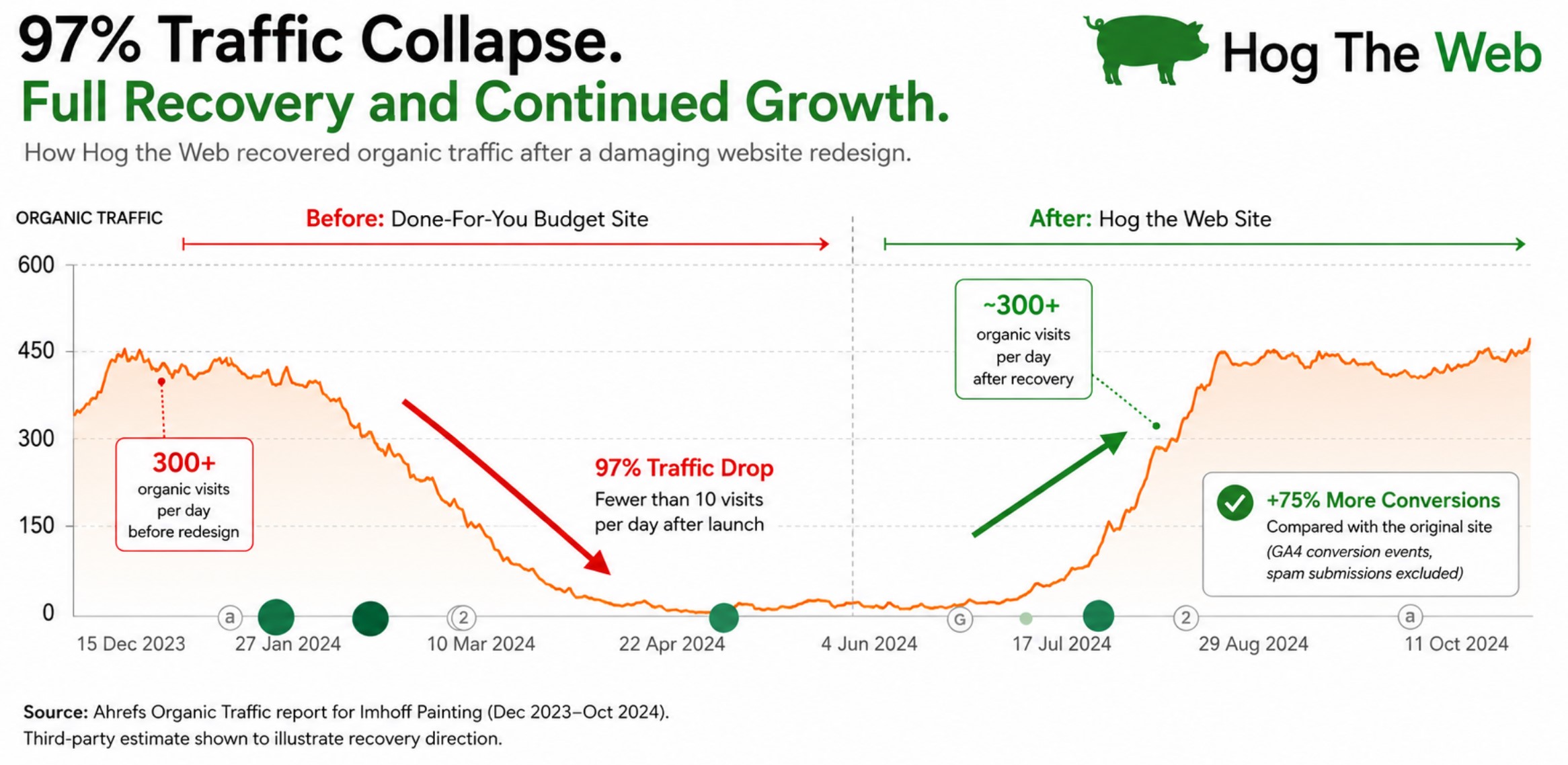
A website redesign is supposed to improve a business. But when a sites existing SEO momentum is ignored in the process, even a beautiful new web design can come with an expensive hidden cost. An organic traffic collapse!
WordPress web design and SEO company Hog the Web helped recover a site when a small family-owned painting business lost 97% of its organic search traffic following a redesign by another provider.
Before the redesign, Imhoff Painting was receiving more than 300 organic website visits per day. After the new website launched, traffic fell to fewer than 10 visits per day.
The problem wasn't just a Google algorithm update.
The problem was that the new website replaced hundreds of blog articles, and dozens of service pages, with a simple 6 page brochure site.
That turned all those existing links into 404 errors. Useful content was lost, as well as years of authority and painting experience they signaled to search engines.
When Imhoff turned to Hog the Web for help, the HTW team took a preservation-first approach.
Rather than starting over again, Hog the Web analyzed the website's previous search performance, restored valuable pages and content, repaired URLs and redirects, preserved existing SEO signals where possible, and rebuilt the WordPress website around the assets that had already proven valuable, based on the data still available in Google Search Console.
Within roughly a month of relaunching the recovered site, organic traffic returned to about 300 visits per day.
The rebuilt website also performed better for visitors once they arrived. According to GA4 conversion-events, conversions increased 75% compared with the original website.
"A redesign doesn't happen in a vacuum," said Levi Meulen of Hog the Web. "An established website may already have years of rankings, backlinks, useful content and search history behind it. We try to identify what's valuable before we replace anything. A prettier website isn't much of an improvement if the pages bringing customers to the business disappear in the process."
The case has helped shape Hog the Web's broader approach to WordPress redesigns and SEO recovery: preserve what's already working first, then improve second.
That approach is increasingly relevant for businesses rebuilding established websites, migrating WordPress installations, changing URL structures or consolidating older content.
A drop in traffic following a redesign can have several causes, including deleted ranking pages, missing redirects, changed URLs, lost internal links, indexation problems, altered canonical tags, substantially reduced content and other technical changes.
Hog the Web's recovery work combines SEO analysis with hands-on WordPress development so that problems can be diagnosed and fixed by the same expert team.
"A lot of SEO engagements end with a report telling the business what its developer needs to fix," Levi said. "Because our SEO and WordPress teams work together, we can usually trace the problem and make the changes ourselves. That becomes especially valuable after a redesign or migration, where the problem may be spread across content, URLs, redirects, WordPress settings and technical SEO all at once."
The company says businesses considering a redesign should carefully evaluate their existing websites search engine footprint before deleting or substantially changing content.
Even pages that are outdated can still hold significant search value through rankings, backlinks, topical relevance and years of accumulated history. In many cases, the better approach is to improve those assets rather than automatically remove them.
The same principle applies after a failed redesign. Returning to the old website is not always necessary, and recovery does not necessarily mean restoring every deleted page. Instead, businesses should determine which lost assets had measurable value and then decide which ones should be restored, improved, consolidated or redirected to an appropriate replacement. This type of analysis now forms part of Hog the Web's approach to SEO recovery and website redesign planning.
Hog the Web has published the complete recovery story, including before-and-after search data and details about the redesign mistakes and recovery process, in its Website Redesign SEO Case Study:
https://hogtheweb.com/case-study/website-redesign-case-study-imhoff/
Businesses looking for WordPress SEO support, including traffic-drop diagnosis, URL and redirect cleanup, content recovery and ongoing search and AI visibility optimization, can learn more at: